The Kyoto Protocol to the United Nations Framework Convention on Climate Change is an amendment to the international treaty on climate change, assigning mandatory targets for the reduction of greenhouse gas The UNFCCC’s Kyoto Protocol was agreed in 1997. It commits 36 of the Convention’s Annex I Parties (known as Annex B Parties) to individual targets for limiting or reducing emissions which, taken together, would reduce overall emissions of six greenhouse gases from these countries by approximately 5 per cent below 1990 levels within the Protocol’s first commitment period (2008-12).
The Protocol’s three main tools for helping Annex B Parties to reach these targets efficiently are:
1. international emissions trading between countries with targets;
2. joint implementation of emissions-reducing projects; and the
3. Clean Development Mechanism (CDM). The CDM allows Annex-I countries to invest in emissions reductions in developing nations rather than directly reduce emissions at home.
Non-Annex I countries do not have legally binding targets to reduce or limit their greenhouse gas emissions during the first commitment period.
The Parties
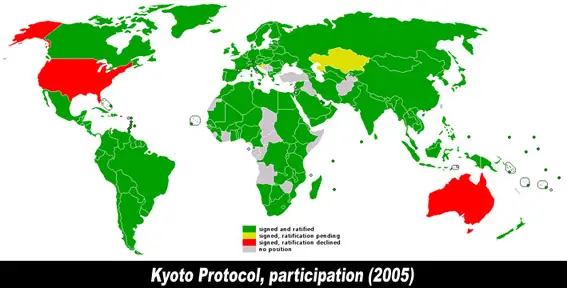
On the map below, the dark green indicates countries that have signed and ratified the treaty and yellow indicates states that have signed and hope to ratify the treaty. The Protocol now has 175 parties — notable exceptions being the United States and Australia. However, in November 2007 a newly elected Labor government in Australia has already moved to ratify the protocol (ratification of the protocol will take effect 90 days after the United Nations receives the instrument of ratification ).
On the map below, the dark green indicates countries that have signed and ratified the treaty and yellow indicates states that have signed and hope to ratify the treaty. The Protocol now has 175 parties — notable exceptions being the United States and Australia. However, in November 2007 a newly elected Labor government in Australia has already moved to ratify the protocol (ratification of the protocol will take effect 90 days after the United Nations receives the instrument of ratification ).


No hay comentarios:
Publicar un comentario