martes, 28 de febrero de 2012


What is The Protocol?
The Kyoto Protocol to the United Nations Framework Convention on Climate Change is an amendment to the international treaty on climate change, assigning mandatory targets for the reduction of greenhouse gas The UNFCCC’s Kyoto Protocol was agreed in 1997. It commits 36 of the Convention’s Annex I Parties (known as Annex B Parties) to individual targets for limiting or reducing emissions which, taken together, would reduce overall emissions of six greenhouse gases from these countries by approximately 5 per cent below 1990 levels within the Protocol’s first commitment period (2008-12).
The Protocol’s three main tools for helping Annex B Parties to reach these targets efficiently are:
1. international emissions trading between countries with targets;
2. joint implementation of emissions-reducing projects; and the
3. Clean Development Mechanism (CDM). The CDM allows Annex-I countries to invest in emissions reductions in developing nations rather than directly reduce emissions at home.
Non-Annex I countries do not have legally binding targets to reduce or limit their greenhouse gas emissions during the first commitment period.
The Parties
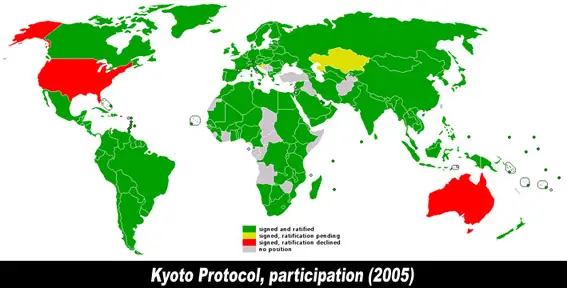
On the map below, the dark green indicates countries that have signed and ratified the treaty and yellow indicates states that have signed and hope to ratify the treaty. The Protocol now has 175 parties — notable exceptions being the United States and Australia. However, in November 2007 a newly elected Labor government in Australia has already moved to ratify the protocol (ratification of the protocol will take effect 90 days after the United Nations receives the instrument of ratification ).
On the map below, the dark green indicates countries that have signed and ratified the treaty and yellow indicates states that have signed and hope to ratify the treaty. The Protocol now has 175 parties — notable exceptions being the United States and Australia. However, in November 2007 a newly elected Labor government in Australia has already moved to ratify the protocol (ratification of the protocol will take effect 90 days after the United Nations receives the instrument of ratification ).
martes, 14 de febrero de 2012


sábado, 4 de febrero de 2012
Alternative transportation
During the last two decades, growth in world GDP was 50%, but the freight increase by 170%. This is done basically by roads, accounting for 75% of world traffic. Compared to what happens or Japan, the U.S. uses more rail than road. This is explained in particular by the greater distances, making the roads to move it more expensive to opt for the railroad. Freight transport depends significantly on oil, and therefore is a factor in climate change.No significant change in the transport of goods is possible without in-depth transform the way we produce and consume. From an optimistic perspective, to protect the planet would have to support business efforts to buy local products that require little transportation. If part of a more realistic (going beyond the good will of companies), should be imposed the relocation of activities applying higher taxes to rebalance the transport cost of production duo transportation costs.Of course the road movement of goods can circumvent the law: How to control the driver in France of a foreign country, for example Bulgarian and Polish, with documents in those languages and who does not speak French? What you have on hand is almost a pass. In the European Union must harmonize the laws of the member countries. The solution to energy problems only move forward if progress is made in the plane of social equality and employment legislation. If the cost and conogramas were the same across the European Union, the strategies of "just in time delivery" and "zero inventory" would lose interest and end up with empty trucks on the return trip, because transport companies would three or four times more expensive. Currently, transport accounts for between 1 and 2% of the total cost of production, a ridiculous value.A 1999 study showed that road traffic covering a maximum of 60% of infrastructure costs it generates. Since then, things have not changed what is important. Taxing road transport would rebalance things and free up funds for non-road infrastructure works. These assessments should take into account the CO2 emissions of the vehicle and its weight would integrate the transport contract and avoid increasing unnecessarily powerful cars with a system of bonuses and penalties based on their level of contamination. Why not create a special regime for the trucks come back empty? ¿E establish toll rates also adapted to the traffic density and vehicle load, road tax that would apply to all highways, roads and urban road works?
CHERRIES OF CHILEThe goods should be used primarily rail and waterways. It's what they claim all those responsible. However, France is planning to build 3000 km of motorways. How many miles of railroad? In Europe are dismantled annually an average of 600 kilometers of railways. Through the Urban Local Plan (PLU), a deputy may refuse to implement logistics platforms intended only for the road. The deputy also require rail crossings for companies that depend on it. But who does? The transport of goods and waste experience tremendous growth. Is mainly by road, accompanied globalization of trade without assuming the cost of the damage occurs (climate change, use of agricultural land for road construction, noise ...). We must reverse this trend quickly.Back to rail would be much easier if the road transport pay its true costs and European legislation is harmonized. That would allow States to fund the removal of rail bottlenecks and development of coastal maritime infrastructure for heavy loads.While waiting to be awarded such charges, as citizens also have the means of action.What we ate for lunch? New Zealand lamb and cherries from Chile, fresh produce flown in ... or prefer lamb purchased in the local market a product? Beyond the great speeches, the reduction of freight also begins in each of our daily actions.
CHERRIES OF CHILEThe goods should be used primarily rail and waterways. It's what they claim all those responsible. However, France is planning to build 3000 km of motorways. How many miles of railroad? In Europe are dismantled annually an average of 600 kilometers of railways. Through the Urban Local Plan (PLU), a deputy may refuse to implement logistics platforms intended only for the road. The deputy also require rail crossings for companies that depend on it. But who does? The transport of goods and waste experience tremendous growth. Is mainly by road, accompanied globalization of trade without assuming the cost of the damage occurs (climate change, use of agricultural land for road construction, noise ...). We must reverse this trend quickly.Back to rail would be much easier if the road transport pay its true costs and European legislation is harmonized. That would allow States to fund the removal of rail bottlenecks and development of coastal maritime infrastructure for heavy loads.While waiting to be awarded such charges, as citizens also have the means of action.What we ate for lunch? New Zealand lamb and cherries from Chile, fresh produce flown in ... or prefer lamb purchased in the local market a product? Beyond the great speeches, the reduction of freight also begins in each of our daily actions.
Suscribirse a:
Entradas (Atom)